
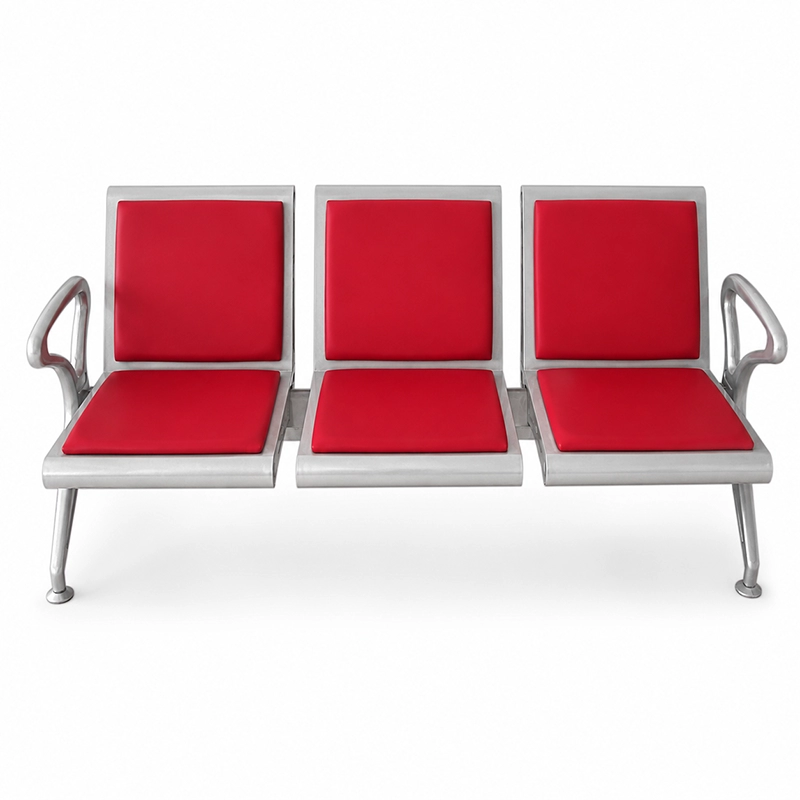
Public row chairs are the workhorses of every high-traffic facility. An airport terminal, a railway station concourse, a hospital outpatient hall and a bank lobby all share the same core requirement: seating that survives thousands of sitting cycles a day without looking worn. This guide explains how the three main construction choices affect durability, comfort and total cost of ownership.
1. The Seat: Self-Skinning PU vs. Upholstered Foam
Self-skinning polyurethane (PU) is produced by injecting foam into a mould so the surface cures into a smooth integral skin. There is no separate fabric cover to tear, no seams to split, and no foam exposed to moisture. That is why PU is the default choice for airport chairs, hospital waiting chairs and infusion chairs - it can be wiped down with hospital-grade disinfectant, resists stains, and holds its shape for years.
Upholstered foam over a plywood shell offers more design flexibility and a softer hand feel, but it needs re-covering over time. For 24/7 public environments, integral-skin PU generally wins on lifecycle cost.
2. The Beam: Steel vs. Aluminum
- Powder-coated steel beam: the most common option. High stiffness, low cost, available in any RAL colour. Requires a quality pre-treatment (degreasing and phosphating) or the coating will chip at the edges.
- Stainless steel beam: best for washdown and corrosive environments - coastal transit hubs, food courts, outdoor covered walkways. Higher cost, but no coating to fail.
- Aluminum beam: roughly one-third the weight of steel, naturally corrosion-resistant, and the right answer when the seating must be moved or installed on lightweight structures.
Whichever you choose, confirm the beam wall thickness and the load test data rather than relying on the visual profile.
3. Configuration and Legs
Row chairs are supplied in 1 to 6 seat units on a common beam, with legs every 3 to 4 seats. Legs may be side-mounted (cleaner look, harder floor fixing) or centre-mounted (easier to install, more floor clearance for cleaning). Armrests and dividing armrests between seats are usually optional, and a beam-end table or a luggage shelf can be added for terminals.
Specification Checklist for Buyers
- Seat material: integral-skin PU (specify density and thickness), upholstered foam, or perforated steel.
- Beam: steel / stainless steel / aluminum, with wall thickness and finish.
- Seat width per person and seat-to-seat pitch - this drives whether the unit fits your floor plan.
- Load rating per seat and the test standard used.
- Fire performance of the foam where required by local code.
- Spare-parts availability: seat shells, armrests and legs should be separately orderable.
Shengke Rui Furniture has manufactured public seating since 1984, supplying self-skinning PU and upholstered row chairs on steel, stainless steel and aluminum beams for airports, stations, hospitals and banks, with OEM/ODM support on dimensions, colour, arms and branding. Contact us for drawings and samples.