
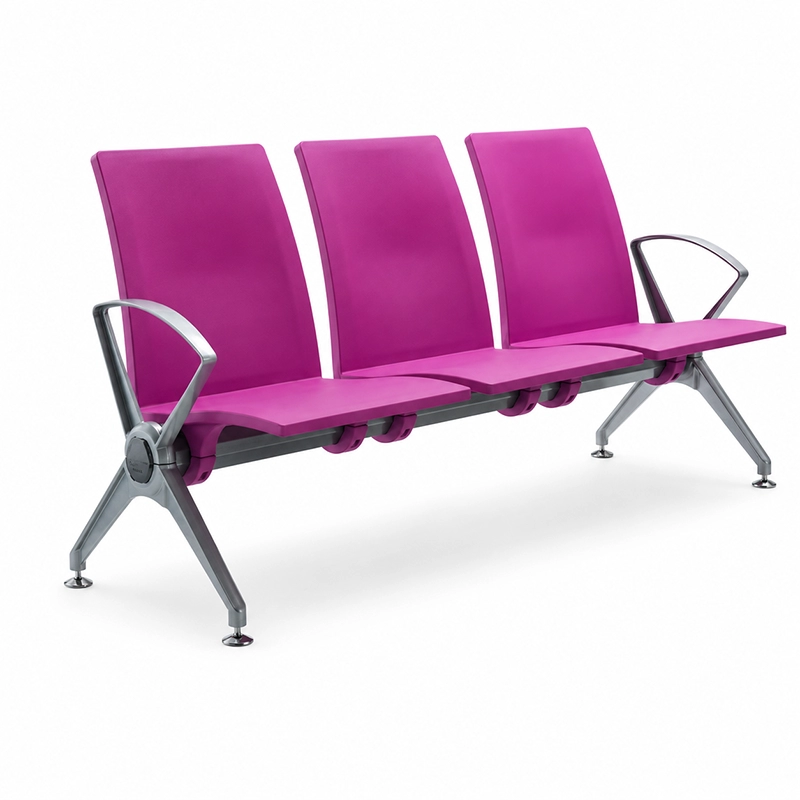
Most enquiries begin with "we need the seating customised". The useful follow-up question is customised where - because a row of public seating is a system of seats, armrests, legs, a beam and finishes, and some of those elements can be changed freely while others are fixed by the mould, the foam and the load behaviour behind them. This guide separates the flexible part from the fixed part, so the brief you send is one a factory can quote without guesswork.
1. Seat Count and Row Configuration
Seat count is the most commonly customised attribute and the easiest to accommodate. Standard rows run from a single seat up to five seats per beam, and the row can be extended or split across bays to suit the layout. In healthcare and transport applications the practical details matter as much as the number: allow 600 to 700 mm of seat pitch in general waiting areas so wheelchairs and walking frames can pass, and provide a clear bay for wheelchair users that does not obstruct circulation - a common planning ratio is roughly one accessible bay per twenty standard seats - the same layout logic is set out in the hospital waiting and infusion chair guide.
2. Armrests, Dividers and Legs
Armrests do two jobs: they define each person's space and they give leverage for standing up, which is why seating for older patients and rehabilitation departments is normally specified with an armrest on every seat. Armrest and divider profile can be changed within the existing tooling, and the legs are where the material choice really matters - steel, stainless steel or aluminum alloy, each with a different weight, corrosion behaviour and appearance - see PU, steel and aluminum options compared.
Aluminum alloy legs and arms reduce the weight of a long row and resist corrosion in humid or coastal environments, while stainless steel is the usual answer where aggressive cleaning agents are used daily. Closed-profile legs with a fully welded bracket are worth specifying in any facility with a fast cleaning routine, because corners take the impact.
3. PU Colour, Texture and Finish
Self-skinning PU is the dominant material in modern public seating for a reason: the moulded integral skin has no fabric surface, no open seams and no exposed foam, so body fluids do not soak in, there are no crevices for dust and pathogens to accumulate, and the surface can be wiped with alcohol, chlorine and quaternary-ammonium disinfectants.
Within that process the colour and surface texture of the seat can be specified, and light neutral tones are usually chosen for healthcare interiors because soiling is easier to spot during inspection. Where upholstery is preferred for appearance, specify a fluid-resistant wipeable cover rather than a woven fabric - woven textiles undo the hygiene advantage that PU was chosen for.
4. Beam Length, Leg Design and Mounting
The beam determines the row length and how the load reaches the floor. Beam length, leg position and leg profile can be adapted to the project, and the choice is normally driven by three things: how many seats the row must carry, what the floor is (concrete, raised floor or tile), and whether the row needs to be anchored or free-standing. A longer beam with an intermediate leg carries more seats without deflection, but it also fixes where the fixing points will land - so the structural drawing and the seating layout need to be read together rather than specified separately.
5. Add-Ons: Infusion Poles, Tables and Power
Infusion chairs are the clearest example of add-on customisation. The seat can accept a dedicated IV pole holder integrated into the beam or frame, or a standard pole on a weighted base beside the seat; the pole should sit within the patient's arm reach with the bag above shoulder height when seated. Companion seating at the same seat height is often added so a family member can sit level with the patient. Writing tablets, power and charging modules, and integrated side tables are further options that change the frame design rather than the seat.
6. Branding and Packaging
Packaging is part of the customisation, not an afterthought. Neutral or custom logo packaging is available, and label content, bundle sizes and how the beams and shells are separated for shipment can be set to suit a site delivery or a distributor warehouse. For distributors, the packing specification is often what makes a product sellable under their own name rather than just shippable.
7. What Cannot Be Customised - and Why
- The foam performance of a seat you have re-shaped: foam density, skin thickness and load rating belong to a specific mould. Change the shell and those figures have to be re-established, not inherited.
- Tooling that does not exist yet: a genuinely new shell or a new leg casting is a mould development project, not a variation of an existing item.
- Seat count beyond the beam's design: a beam designed for four seats can be extended, but only within its span and fixing arrangement - beyond that it is a different structure.
- Hygiene claims on a woven cover: a fabric seat cannot offer the wipe-clean, non-absorbent performance of an integral-skin PU shell, whatever the coating.
- Disinfectant compatibility that has not been confirmed: chemical resistance is a property to be verified and stated in writing, not assumed from the material name.
8. Procurement Checklist
- Row configuration and total seat count, bay by bay, including wheelchair-accessible positions.
- Armrest and divider style, and the leg material - steel, stainless steel or aluminum alloy.
- Seat surface colour and texture, with the cleaning regime it has to survive.
- Beam length and leg positions checked against the floor and fixing points.
- Add-ons - IV pole holder, companion seat, tables, power - confirmed at frame design stage.
- Packing specification: neutral or logo, bundle sizes and label content.
- Whether a sample or a mould development is required for the non-standard items.
For the seating side of transport projects, see how to choose airport waiting chairs.
Shengke Rui Furniture has manufactured public seating since 1984, including hospital waiting chairs and infusion chairs in self-skinning PU on steel, stainless steel and aluminum alloy beams. Our PU range runs from single seats to five-seat rows, with multiple armrest and leg options, and we support full OEM/ODM customisation for healthcare, transit and institutional projects worldwide. Contact us for specifications, drawings and samples.